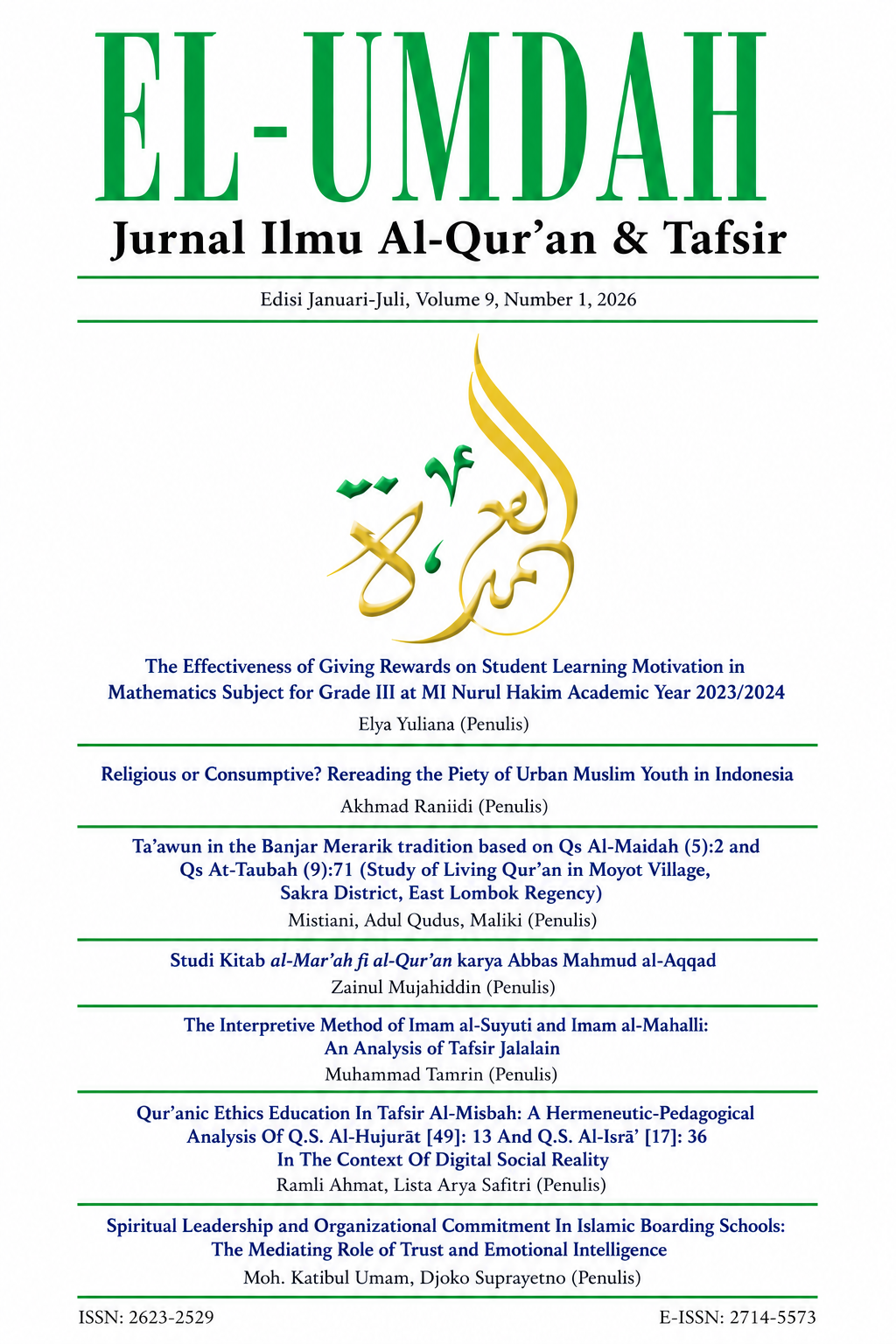
Qur’anic Ethics Education In Tafsir Al-Misbah: A Hermeneutic-Pedagogical Analysis Of Q.S. Al-Hujurāt [49]: 13 And Q.S. Al-Isrā’ [17]: 36 In The Context Of Digital Social Reality
Keywords:
Qur’anic Ethics Education, Tafsir al-Misbah, Q.S. al-Hujurāt, Q.S. al-Isrā’, Digital Ethics, Islamic PedagogyAbstract
This study examines the gap between Indonesia’s expanding digital social reality and the absence of a systematic Qur’anic ethical framework to address moral crises such as intolerance and disinformation. The research analyzes Qur’anic ethics education in Tafsir al-Misbah by focusing on Q.S. al-Hujurāt [49]:13 and Q.S. al-Isrā’ [17]:36, while exploring their implications for digital-age Islamic education. Using a qualitative hermeneutic-pedagogical approach, the study combines thematic exegesis (al-tafsīr al-mawḍū‘ī), content analysis, and Izutsu’s semantic framework to examine the historical, linguistic, and moral dimensions of both verses. The findings show that Q.S. al-Hujurāt [49]:13 emphasizes human equality and ta‘āruf (mutual recognition) as an ethical basis for plurality and social inclusivity. Meanwhile, Q.S. al-Isrā’ [17]:36 highlights epistemic accountability, warning against spreading unverified information, a principle highly relevant to digital ethics and disinformation. Together, the two verses establish a Qur’anic ethical framework grounded in social inclusivity and intellectual integrity. The study suggests integrating these values into Islamic Religious Education (PAI) through multicultural pedagogy and digital literacy. It also contributes to the emerging field of Islamic digital ethics by connecting tafsir studies, character education, and information ethics within a practical pedagogical framework.
References
APJII. (2023). Laporan Survei Penetrasi Internet Indonesia 2023. Jakarta: Asosiasi Penyelenggara Jasa Internet Indonesia.
Banks, J. A. (2010). Multicultural education: Issues and perspectives (7th ed.). Hoboken, NJ: Wiley.
BPS. (2020). Statistik Penduduk Menurut Agama. Jakarta: Badan Pusat Statistik.
Creswell, J. W., & Poth, C. N. (2018). Qualitative inquiry and research design: Choosing among five approaches (4th ed.). Thousand Oaks, CA: Sage.
Darraz, M. A. (1997). Dustūr al-akhlāq fī al-Qur’ān. Beirut: Mu’assasah al-Risālah.
al-Farmāwī, ‘A. H. (1977). Al-bidāyah fī al-tafsīr al-mawḍū‘ī. Cairo: al-Haḍārah al-‘Arabiyyah.
Floridi, L. (2014). The ethics of artificial intelligence. Oxford: Oxford University Press.
Freire, P. (1970). Pedagogy of the oppressed. New York: Continuum.
Gadamer, H. G. (2004). Truth and method (2nd rev. ed., J. Weinsheimer & D. G. Marshall, Trans.). London: Continuum.
Izutsu, T. (1966). Ethico-religious concepts in the Qur’an. Montreal: McGill University Press.
Kemenag RI. (2022). Moderasi beragama: Dari Indonesia untuk dunia. Jakarta: Kementerian Agama RI.
Kemendikbudristek. (2022). Kurikulum Merdeka: Panduan implementasi. Jakarta: Kemendikbudristek.
Kominfo RI. (2023). Laporan Penanganan Konten Disinformasi 2023. Jakarta: Kementerian Komunikasi dan Informatika.
Lickona, T. (1991). Educating for character: How our schools can teach respect and responsibility. New York: Bantam Books.
Lincoln, Y. S., & Guba, E. G. (1985). Naturalistic inquiry. Beverly Hills, CA: Sage.
Malik ibn Anas. (n.d.). Al-Muwaṭṭa’. Beirut: Dār al-Kutub al-‘Ilmiyyah.
Microsoft. (2022). Digital Civility Index 2022. Redmond, WA: Microsoft Corporation.
Miles, M. B., & Huberman, A. M. (1994). Qualitative data analysis: An expanded sourcebook (2nd ed.). Thousand Oaks, CA: Sage.
Nata, A. (2012). Manajemen pendidikan: Mengatasi kelemahan pendidikan Islam di Indonesia. Jakarta: Kencana Prenada Media Group.
Nurhayati, S. (2016). Nilai-nilai pendidikan akhlak dalam Tafsir al-Misbah [Undergraduate thesis]. UIN Syarif Hidayatullah Jakarta.
OECD. (2023). PISA 2022 results. Paris: OECD Publishing.
Oktaviani, R. (2025). Konsep pendidikan karakter dalam Tafsir al-Misbah [Undergraduate thesis]. UIN Sunan Kalijaga Yogyakarta.
Rahman, F. (2009). Major themes of the Qur’an (2nd ed.). Chicago: University of Chicago Press.
Rest, J. R. (1986). Moral development: Advances in research and theory. New York: Praeger.
Ricoeur, P. (1976). Interpretation theory: Discourse and the surplus of meaning. Fort Worth, TX: Texas Christian University Press.
Saeed, A. (2006). Interpreting the Qur’an: Towards a contemporary approach. London: Routledge.
SETARA Institute. (2023). Laporan Kebebasan Beragama dan Berkeyakinan di Indonesia 2023. Jakarta: SETARA Institute.
Shihab, M. Q. (2002). Tafsir al-Misbah: Pesan, kesan dan keserasian al-Qur’an (15 vols.). Jakarta: Lentera Hati.
Tafsir, A. (2013). Ilmu pendidikan dalam perspektif Islam. Bandung: Remaja Rosdakarya.
Transparency International Indonesia. (2023). Corruption Perceptions Index 2023: Indonesia. Jakarta: TII.
UNESCO. (2022). Recommendation on the ethics of artificial intelligence. Paris: UNESCO.
Wahid Foundation. (2022). Survei Nasional tentang Radikalisme dan Toleransi 2022. Jakarta: Wahid Foundation.
Zagzebski, L. T. (1996). Virtues of the mind: An inquiry into the nature of virtue and the ethical foundations of knowledge. Cambridge: Cambridge University Press.
Zainuddin, A. (2020). Etika sosial dalam tafsir al-Qur’an kontemporer: Studi komparatif Tafsir al-Misbah dan Tafsir al-Azhar [Master’s thesis]. UIN Sunan Gunung Djati Bandung.
Downloads
Published
Issue
Section
License
Copyright (c) 2026 el-Umdah

This work is licensed under a Creative Commons Attribution-ShareAlike 4.0 International License.